
Commercial systems have always optimised for performance.
- Newspapers optimised for circulation.
- Television optimised for ratings.
- Advertising optimised for attention.
- Retail optimised for conversion.
Digital systems are no different … systems are generally deployed to be useful within the context of their objectives.
- A banking platform optimises for transactional integrity.
- A logistics platform optimises for coordination efficiency.
- A point-of-sale system optimises for commercial throughput.
- A distributed denial-of-service mesh optimises for disruption.
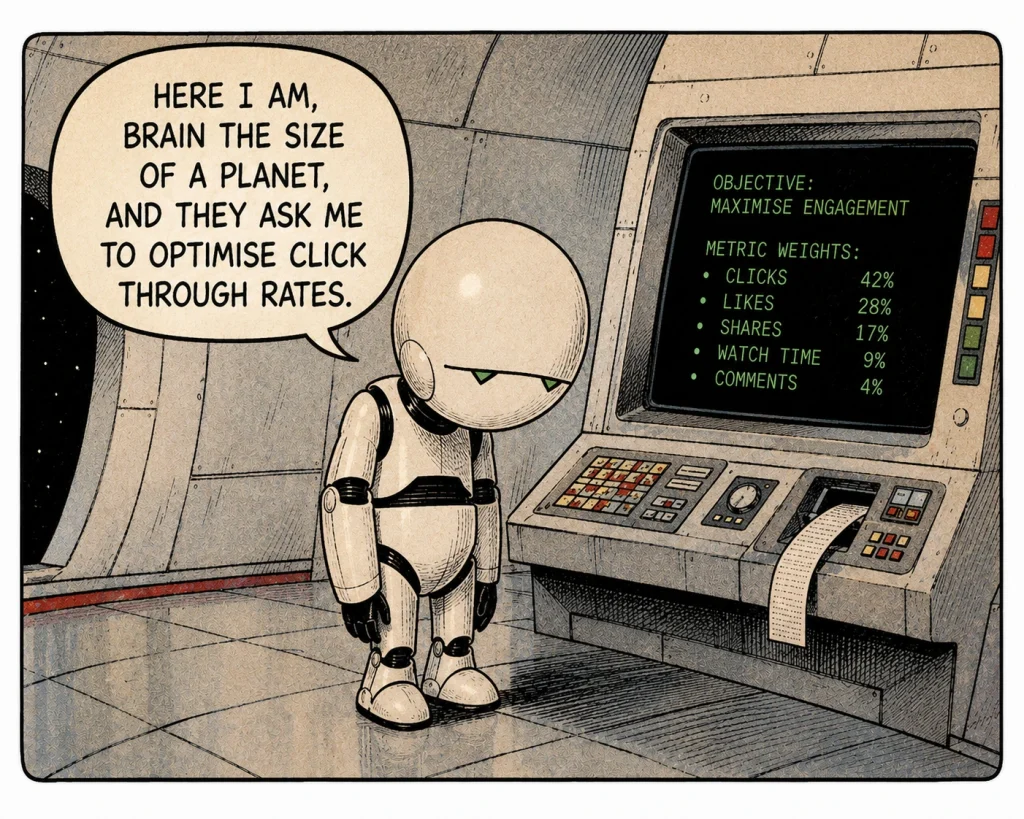
Computers are, in many ways, high-speed idiots.
A computer consumes data. Some of this data we call a program … a collection of instructions. It takes those instructions and doggedly executes them without concern for productive intent, meaning, or accomplishment.
In fact, if instructed poorly, a computer will quite happily execute itself forever in an infinite loop until eventually deprived of time, resources, or energy.
That is not to say computers are not capable. They are extraordinarily capable at executing functions … including optimisation functions … but they remain entirely dependent on objectives, inputs, constraints, and feedback signals.
What changed with the modern internet was not optimisation itself. What changed was the scale, speed, precision, and automation of optimisation. Digital platforms became capable of continuously measuring behavioural response in real time, embedding their users directly into the feedback signals …
- Attention became quantifiable.
- Engagement became measurable.
- Behaviour became modelable.
- And eventually, behaviour became modifiable.
Not even necessarily through direct coercion … but through adaptive feedback environments. This created evolutionary pressure not only on platforms, but on users themselves.
In retrospect, it was probably naive and idealistic to believe this would not happen. Humans are cognitively malleable, evolutionary in origin and very good at adapting to environments … and digital systems increasingly became behavioural environments.
- Users learned which behaviours gained visibility.
- Creators learned which behaviours gained reach.
- Media organisations learned which behaviours gained engagement.
- Political actors learned which behaviours gained traction.
The ecosystem trained its participants.
Importantly, the systems themselves are not “believing” anything in a human sense. The issue is not machine intention. The issue is the feedback loop between optimisation systems and human behavioural ensembles.
- Modified behaviours influence collective beliefs.
- Collective beliefs influence future behaviours.
- Future behaviours generate new optimisation signals.
flowchart TD
    A[Modified Behaviours]
    B[Collective Beliefs]
    C[Future Behaviours]
    D[Optimisation Signals]

    A --> B
    B --> C
    C --> D
    D -.feedback shaping.-> A
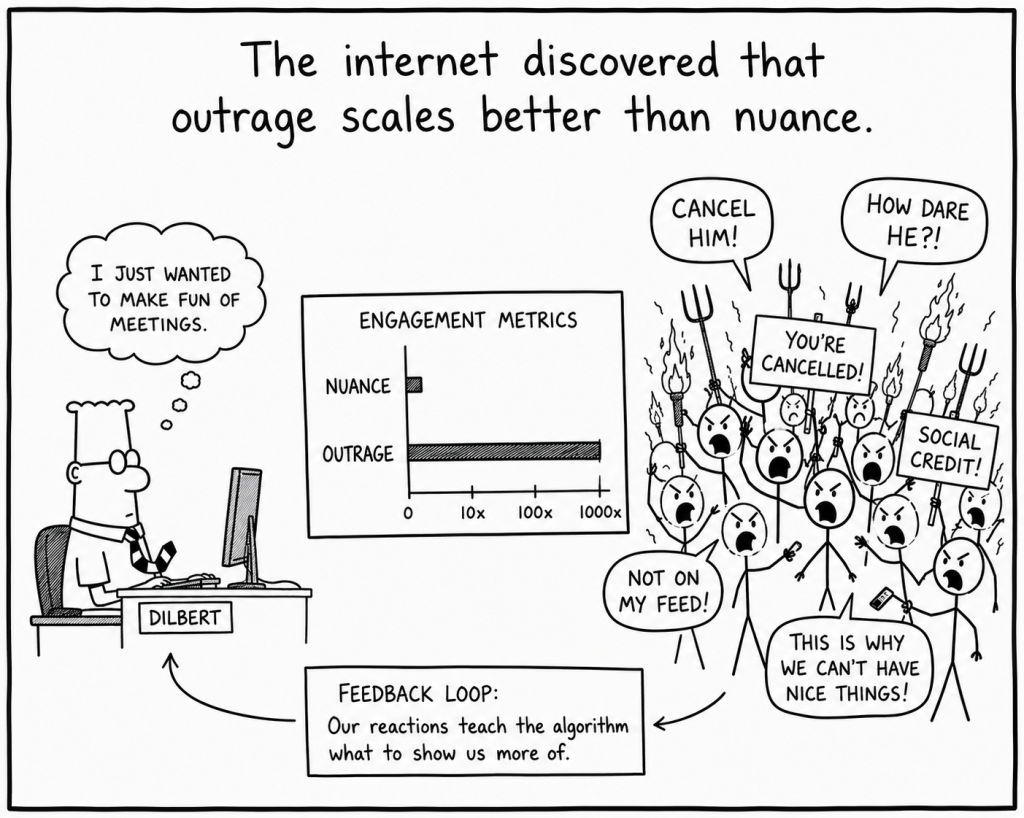
The loop reinforces itself (with all the dangers that are implied by positive feedback).
This is why the modern information environment increasingly behaves less like a passive communications network and more like an adaptive evolutionary ecosystem. Selection pressures emerge from measurable success criteria … and systems naturally amplify behaviours correlated with those success metrics. This is simple but important:
If engagement is rewarded, engagement-driving traits spread.
Often:
- certainty
- tribal signalling
- novelty
- entertainment
- fear
- identity reinforcement
- emotional activation
- extremism
Not because these traits are necessarily true (or not) … but because they perform effectively within this environment itself
The issue is not simple noise amplification. in fact … random noise often diminishes through aggregation. The problem emerges when optimisation systems selectively reinforce correlated behavioural patterns across massive networks of participants. At that point the ecosystem no longer behaves like independent distributed signal sensing … instead it begins behaving like a recursive feedback system.
It is the large-scale amplification of behaviours, biases, and signals.
If signal integrity matters, over time it degrades as correlated amplification increases. Nuance compresses … reflection slows … reaction accelerates … memetic cascades outrun personal and institutional adaptation.
My generation built extraordinarily fast behavioural feedback systems without equivalent advances in things like epistemics, collective sensemaking, cognitive resilience, institutional adaptation and information hygiene.
The high-speed idiot has become even more decoupled from wisdom.
We remain inside the optimisation loop and the ecosystem increasingly shapes us – the societies participating within it.
Ecosystems evolve toward the rewards we build into them. All the criticisms aimed at Millennials and Gen Alpha may have missed the point. This year’s Darwin Awards go to Gen X.
Which raises the next critical question: If digital ecosystems inevitably shape behaviour, then what kinds of behaviours should future ecosystems reward?